Mary Coloring Pages — Free Printable Bible Pages
Free Mary mother of Jesus coloring pages featuring the Annunciation, Nativity, Visitation, and Holy Family. Perfect for Advent and Christmas Sunday school.
All Mary Mother of Jesus coloring pages (3)
Frequently Asked Questions
Are these Bible coloring pages really free?+
Yes — every Bible coloring page on this site is completely free to download, print, and use for personal, classroom, homeschool, and church purposes. No subscription, no email signup, no watermarks.
What format do I download?+
Each coloring page is available as a high-resolution PNG (2000×2000 pixels, A4 print-ready) and viewable on the page as a WebP image. Click the Download button to save the PNG to your device, or use the Print button to print directly from your browser.
Can I use these coloring pages in my church or Sunday school?+
Absolutely. Our free license permits classroom, Sunday school, VBS, and church-bulletin use, including making multiple copies for your students. The only restriction is that you may not resell or include them in a paid product.
Which age groups are these pages for?+
We offer variants for toddlers (ages 2–4), preschool (3–5), kindergarten (5–6), elementary kids (6–10), teens (11–17), and adults. Each leaf page is clearly labeled for an age range, with simpler or more detailed line art accordingly.
How often do you add new coloring pages?+
We publish new Bible coloring pages weekly, with seasonal collections (Christmas, Easter, VBS) refreshed every year before the holiday season. Subscribe to our newsletter to get new pages first.
Mary, Mother of Jesus coloring pages — Annunciation through Pentecost
Mary is the most frequently depicted woman in Western art history. From Byzantine icons to Renaissance altarpieces to contemporary Catholic devotional imagery, no other female figure has received comparable artistic attention across two thousand years. For Christian children's ministry — Catholic, Orthodox, Anglican, and many Protestant traditions — Mary is a central figure in the Christmas story and a model of faithful response to God's call.
This Mary section holds every page on the site depicting the Blessed Virgin Mary — from the Annunciation through Pentecost, including the Catholic Marian devotional images, the post-Resurrection biblical scenes, and the ecumenically-accessible gospel narrative pages.
What the Mary catalog covers
Annunciation and Visitation
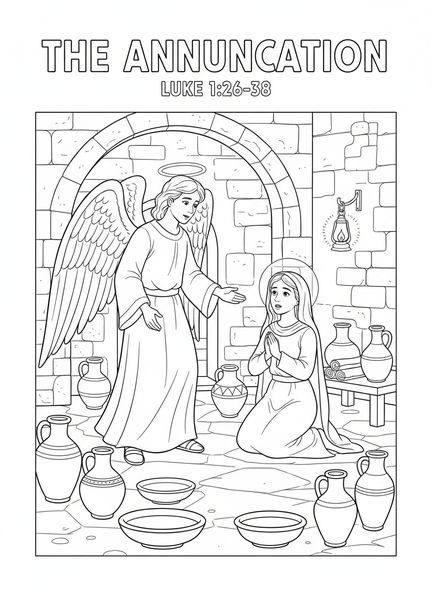
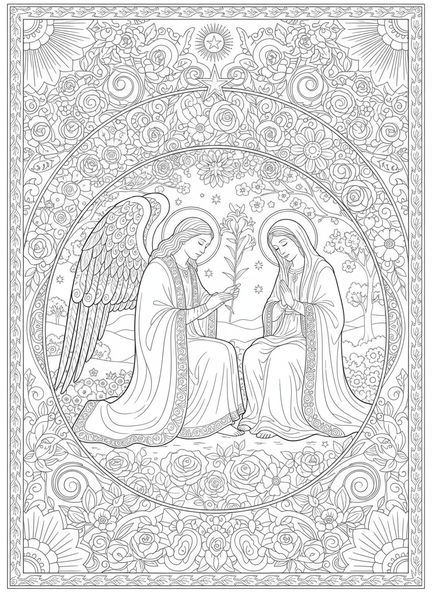
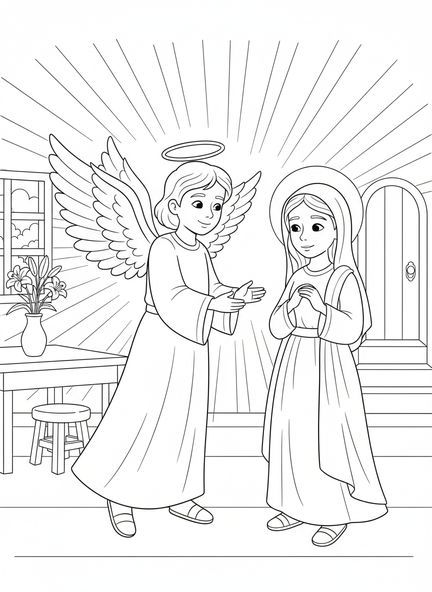
- The Annunciation (Luke 1:26-38) — Gabriel announcing the conception
- The Visitation (Luke 1:39-56) — Mary visiting Elizabeth, the Magnificat
- The Magnificat — Mary's song of praise, suitable for older kids and adults
Christmas narratives
- The Journey to Bethlehem (Luke 2:1-5)
- The Nativity (Luke 2:6-7) — Mary holding the newborn
- Mary with the shepherds (Luke 2:15-20)
- The presentation in the Temple (Luke 2:22-38) — Simeon's prophecy
The early life of Jesus
- The flight to Egypt (Matthew 2:13-18) — Mary, Joseph, and the child
- The boy Jesus in the temple (Luke 2:41-52) — Mary finding her son
Jesus' public ministry
- The wedding at Cana (John 2:1-12) — Mary's instruction: "Do whatever he tells you"
- Mary visiting Jesus during ministry (Matthew 12:46-50, Mark 3:31-35, Luke 8:19-21)
The Passion and Resurrection
- Mary at the foot of the cross (John 19:25-27) — "Woman, behold your son"
- The Pieta — Mary holding the body of Jesus (traditional, drawing on the gospel burial accounts)
- Mary in the upper room at Pentecost (Acts 1:14, 2:1-4) — the Mother of the Church
Catholic Marian devotional content
For Catholic users, we publish dedicated Marian devotional pages beyond the gospel narratives:
Marian apparitions and feast days
- Our Lady of Guadalupe (December 12) — the 1531 apparition to Juan Diego in Mexico
- Our Lady of Fatima (May 13) — the 1917 apparitions to three shepherd children in Portugal
- Our Lady of Lourdes (February 11) — the 1858 apparitions to Saint Bernadette in France
- Our Lady of Mt. Carmel (July 16) — Carmelite devotion
- The Immaculate Conception (December 8) — the dogma of Mary's conception without original sin
Marian doctrines (in age-appropriate form)
- The Mother of God (Theotokos) — defined at Ephesus 431
- The Immaculate Conception — defined by Pope Pius IX 1854
- The Assumption — defined by Pope Pius XII 1950
- The Queen of Heaven — coronation imagery
Marian devotional practices
- The Rosary — see our Rosary section for the 20 mysteries
- The Memorare prayer — Saint Bernard's prayer, illustrated
- The Salve Regina — the closing antiphon of the Rosary
- Marian feast day icons — for the major Marian feasts
Sunday school and CCD workflow with Mary content
Different Christian traditions integrate Marian content differently:
Catholic CCD workflow
Mary appears throughout the year: Advent (Annunciation), Christmas (Nativity), Lent (Pieta, Sorrowful Mother), Easter (post-Resurrection appearances), May (the traditional month of Mary, May Crowning ceremonies), October (the month of the Rosary).
Protestant Sunday school workflow
Mary appears primarily in the Christmas curriculum. Mainline Protestant traditions (Lutheran, Anglican, Methodist) include the Annunciation and the Magnificat more substantively; evangelical traditions tend to focus on the Nativity scene.
Eastern Orthodox workflow
Mary (the Theotokos) is central to Orthodox spiritual life. Our adult intricate Mary pages draw on Eastern iconographic tradition, suitable for Orthodox parish use.
How we depict Mary
Across all pages, Mary is depicted with consistent iconographic conventions:
Color symbolism
- Blue mantle — the dominant color, representing heavenly grace
- White or red veil — varying by tradition (red is more Eastern Orthodox; white is more Western Catholic)
- Gold halo in adult devotional pages — following established iconographic tradition
Posture
- Hands folded in prayer — the most common pose
- Holding the Christ child — in nativity and devotional images
- Kneeling — in scenes of receiving the angelic message
- Standing at the cross — in Passion narratives
Age
- Young woman (mid-teens to early twenties) in Annunciation and Nativity scenes — historically accurate for first-century Jewish women at marriageable age
- Adult mother (twenties to thirties) during Jesus' public ministry
- Older woman (forties to fifties) in Passion and Pentecost scenes
Setting
- Nazareth interior for the Annunciation — simple home, sparse furnishings
- Bethlehem stable for the Nativity
- Calvary and Jerusalem for the Passion narratives
Why we publish Mary content
For ecumenical clarity: we publish Mary content because Mary is in the canonical gospels, and because Mary is centrally important to substantial Christian traditions (Catholic, Orthodox, Anglican, Lutheran, and increasingly evangelical post-N.T. Wright reception).
We don't take denominational positions on contested Marian doctrines. The Immaculate Conception and Assumption are presented as Catholic dogmas — Catholic users will recognize them, Protestant users will understand the context. We don't argue for or against these doctrines on the pages themselves.
For Protestant users uncomfortable with explicit Marian devotional content, our gospel-narrative Mary pages (Annunciation, Nativity, foot-of-cross, Pentecost) work without the devotional layer. For Catholic users, the full Marian catalog including the dogmatic content is available.
Editorial standards for Mary content
Standard editorial policy applies. Three Mary-specific notes:
Theological precision on disputed doctrines
We follow Catholic teaching where Catholic doctrines are explicit (Immaculate Conception, Assumption, Mother of God). We follow gospel narrative where the canonical text is explicit. Where traditions differ, we publish the variants separately rather than blending.
Iconographic accuracy
We follow established iconographic conventions from Eastern Orthodox (for adult intricate pages), Western Catholic (for Marian devotional pages), and ecumenical Protestant (for gospel-narrative pages). We don't invent new iconographic conventions for Mary.
Cultural respect
Mary is depicted as a first-century Jewish woman with Middle Eastern features. For the Marian apparitions (Guadalupe, Fatima, Lourdes), we follow the established depictions from those traditions (Our Lady of Guadalupe is depicted with the indigenous Mexican features she revealed to Juan Diego, etc.).
Multilingual Marian content
Mary is central to the Catholic devotional life across multiple language traditions:
- Spanish — Nuestra Señora de Guadalupe, Latin American Marian devotion
- Portuguese — Nossa Senhora de Fatima, Marian devotion in Brazil and Portugal
- Polish — Matka Boża (Mother of God), Częstochowa icon
- Dutch and German — Reformed Mary content with appropriate theological calibration
- French — Notre Dame de Lourdes, French Marian devotion
Each localized Marian bundle uses the appropriate Bible translation and includes culturally-specific Marian traditions.
What's coming next for Mary content
Publishing priorities over the next 90 days:
- The Seven Sorrows of Mary — companion to the Stations of the Cross
- The Marian feast day calendar — illustrated pages for every major Marian feast
- Mary in the Old Testament typology — adult Catholic theological pages on Marian Old Testament prefigurations
- The "Hail Mary" prayer card series — for first-grade catechism programs
- Marian art history — for adult contemplative use, illustrated overview of Marian iconographic tradition
If your parish or family wants specific Marian content, email us.
Related Bible characters and Catholic devotions
- All Bible characters — browse 30+ figures
- Jesus Christ — Mary's son, the central Christian figure
- Joseph — Mary's husband, foster father of Jesus
- Saint Joseph — Mary's husband as Catholic devotional
- Catholic saints — Mary among the canonized
- Rosary mysteries — Marian prayer practice
— Sarah Mitchell, Christian Education Editor