Paul the Apostle Coloring Pages — Free Printable
Free Paul the Apostle coloring pages featuring his Damascus conversion, missionary journeys, prison letters, and Mars Hill sermon.
All Paul the Apostle coloring pages (23)
Paul Writing Letters Coloring Page for Adults
6 pages · free printable
Paul Writing Letters Coloring Page Sunday School
6 pages · free printable
Paul Rome Coloring Page for Adults
6 pages · free printable
Paul Rome Coloring Page Sunday School
6 pages · free printable
Paul Corinth Coloring Page for Adults
6 pages · free printable
Paul Corinth Coloring Page Sunday School
6 pages · free printable
Paul Athens Coloring Page for Adults
6 pages · free printable
Paul Athens Coloring Page Sunday School
6 pages · free printable
St Pope John Paul II Coloring Page for Sunday School
6 pages · free printable
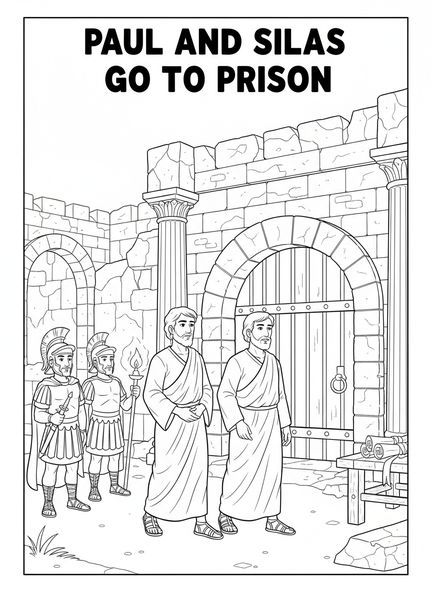
Paul and Silas in Jail Coloring Page for Sunday School
4 pages · free printable
St Pope John Paul II Coloring Page for Adults
5 pages · free printable
St Paul the Apostle Coloring Page for Sunday School
6 pages · free printable
Paul And Silas In Jail Coloring Page For Adults
3 pages · free printable

Paul's Conversion Coloring Page for Preschoolers
5 pages · free printable
Paul's Shipwreck Coloring Page for Kids
5 pages · free printable
St Paul the Apostle Coloring Page for Adults
6 pages · free printable
Paul's Conversion Coloring Page for Sunday School
4 pages · free printable

Paul's Conversion Coloring Page for Adults
5 pages · free printable
St Vincent de Paul Coloring Page for Kids
4 pages · free printable
St Pope John Paul II Coloring Page for Kids
6 pages · free printable
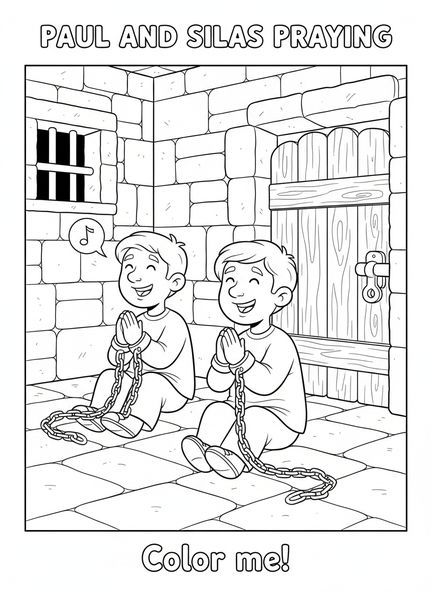
Paul And Silas In Jail Coloring Page for Kids
5 pages · free printable
St Paul the Apostle Coloring Page for Kids
5 pages · free printable
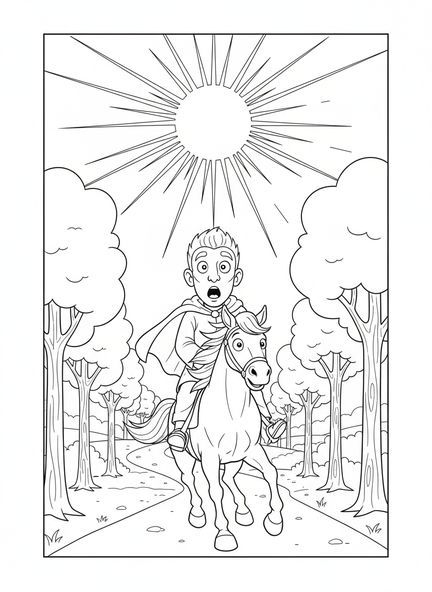
Paul's Conversion Coloring Page for Kids
6 pages · free printable
Frequently Asked Questions
Are these Bible coloring pages really free?+
Yes — every Bible coloring page on this site is completely free to download, print, and use for personal, classroom, homeschool, and church purposes. No subscription, no email signup, no watermarks.
What format do I download?+
Each coloring page is available as a high-resolution PNG (2000×2000 pixels, A4 print-ready) and viewable on the page as a WebP image. Click the Download button to save the PNG to your device, or use the Print button to print directly from your browser.
Can I use these coloring pages in my church or Sunday school?+
Absolutely. Our free license permits classroom, Sunday school, VBS, and church-bulletin use, including making multiple copies for your students. The only restriction is that you may not resell or include them in a paid product.
Which age groups are these pages for?+
We offer variants for toddlers (ages 2–4), preschool (3–5), kindergarten (5–6), elementary kids (6–10), teens (11–17), and adults. Each leaf page is clearly labeled for an age range, with simpler or more detailed line art accordingly.
How often do you add new coloring pages?+
We publish new Bible coloring pages weekly, with seasonal collections (Christmas, Easter, VBS) refreshed every year before the holiday season. Subscribe to our newsletter to get new pages first.
Paul the Apostle coloring pages — from Damascus road to Rome
Paul of Tarsus is the most theologically influential human author in the New Testament. Thirteen of the 27 books carry his name. The bulk of the second half of Acts narrates his missionary journeys. His Damascus-road conversion is one of the most dramatic personal narratives in scripture, and his subsequent journeys planted churches across the Eastern Mediterranean — Antioch, Corinth, Ephesus, Philippi, Thessalonica, Rome — that became the backbone of Christianity's first three centuries.
This Paul section holds every page on the site depicting Paul, from his early life as a Pharisee through his Roman imprisonment and traditional martyrdom under Nero.
The major Paul scenes
Before conversion (as Saul)
- Saul guarding the cloaks at Stephen's stoning (Acts 7:54-8:1) — adult-tier content
- Saul persecuting the church (Acts 8:1-3, 9:1-2) — riding to Damascus
The Damascus road
- The conversion of Saul (Acts 9:1-19) — the most-illustrated Paul scene — the light, the voice ("Saul, Saul, why do you persecute me?"), the blindness
- Ananias baptizing Saul (Acts 9:10-19) — the disciple sent to heal Saul
- Saul's first preaching in Damascus (Acts 9:19-25) — lowered in a basket over the wall
Early ministry
- Barnabas brings Saul to the apostles (Acts 9:26-30) — the mediator who vouches for him
- At Antioch, the disciples are first called Christians (Acts 11:19-26)
- Paul and Barnabas commissioned (Acts 13:1-3) — the laying on of hands
First missionary journey
- Cyprus (Acts 13:4-12) — Paul converts Sergius Paulus
- Antioch of Pisidia (Acts 13:13-52) — synagogue sermon
- Iconium, Lystra, Derbe (Acts 14) — the stoning at Lystra
- The Jerusalem Council (Acts 15) — the Gentile question resolved
Second missionary journey
- Macedonian call (Acts 16:9-10) — "Come over to Macedonia and help us"
- Lydia in Philippi (Acts 16:11-15) — first European convert
- Paul and Silas in prison (Acts 16:25-34) — the earthquake, the Philippian jailer
- In Thessalonica and Berea (Acts 17:1-15)
- Paul at Mars Hill / Areopagus (Acts 17:16-34) — the sermon to the Athenians, "the unknown god"
- In Corinth (Acts 18:1-17) — with Aquila and Priscilla
Third missionary journey
- Paul in Ephesus (Acts 19) — the riot of the silversmiths
- The farewell at Miletus (Acts 20:17-38) — the Ephesian elders weep
Imprisonment and the journey to Rome
- Arrested in Jerusalem (Acts 21-23)
- Before Felix, Festus, Agrippa (Acts 24-26)
- Paul appeals to Caesar (Acts 25:10-12)
- The shipwreck at Malta (Acts 27) — the storm, the centurion, the survivors
- Paul in Rome (Acts 28) — house arrest, writing the prison epistles
- Tradition: Paul's martyrdom under Nero — beheaded (extra-biblical tradition)
Paul as author
The thirteen Pauline epistles span the second half of the New Testament:
- Romans — the systematic theology of salvation
- 1 and 2 Corinthians — pastoral letters to a difficult church
- Galatians — the gospel of grace defended
- Ephesians — the cosmic Christ, the armor of God
- Philippians — joy from prison
- Colossians — Christ's preeminence
- 1 and 2 Thessalonians — the return of Christ
- 1 and 2 Timothy and Titus — the Pastoral Epistles
- Philemon — the personal letter about Onesimus
Why Paul matters for kids
Three observations from teaching Paul's story:
1. The dramatic conversion is gripping
Saul-becomes-Paul is the most dramatic conversion narrative in the Bible. The before-and-after is total. Kids understand transformation through this story — God changes people who seem unlikely.
2. The journeys are adventure stories
Storms, shipwrecks, prison breaks, riots, escaping over walls in baskets — Paul's life is an adventure narrative. Kids who tune out epistle theology engage strongly with the Acts narrative.
3. The theology is foundational
For older kids and teens, Paul's epistles provide the theological framework that anchors Christian belief: grace, justification by faith, the unity of the church, the resurrection hope, the ethical implications of the gospel. These are foundational for catechetical formation.
Sunday school workflow for Paul
A 5-week Paul unit:
Week 1 — Saul the persecutor
- Read Acts 7:54-8:3 and 9:1-2
- Color the Saul-with-cloaks (preschool-safe version) and Saul on the road to Damascus
- Discussion: "Sometimes the people who seem furthest from God become the closest. How does God change people?"
Week 2 — The Damascus road
- Read Acts 9:1-19
- Color the conversion scene
- Discussion: "Saul heard Jesus say, 'Why do you persecute me?' What does this tell us about how Jesus feels when his people are hurt?"
Week 3 — Paul and Silas in prison
- Read Acts 16:16-40
- Color the prison-earthquake bundle
- Discussion: "Paul and Silas sang hymns in prison. What do you do when you're stuck in something hard?"
Week 4 — Paul at Mars Hill
- Read Acts 17:16-34
- Color the Athens-altars scene
- Discussion: "Paul met the Athenians where they were. How do we talk about God to friends who don't know him?"
Week 5 — The shipwreck and Rome
- Read Acts 27-28
- Color the shipwreck bundle
- Discussion: "Paul reached Rome through a shipwreck. Sometimes God uses hard journeys to get us where we need to be."
This 5-week Paul unit covers the dramatic narrative arc without requiring kids to engage Pauline epistolary theology at depth (which is reserved for teen and adult tiers).
Editorial standards for Paul content
Standard editorial policy applies. Three Paul-specific notes:
Iconographic conventions
Paul is depicted with consistent conventions:
- Receding hair / bald (consistent with patristic tradition; the Acts of Paul and Thecla describes him this way)
- Long beard
- Carrying scrolls or a sword (the sword symbolizing his Roman citizenship in some traditions, or his martyrdom by beheading)
- Robes in apostolic style — adapted by setting (Jewish robes in early pages, Roman-citizen style in later)
Historical and cultural accuracy
The Mediterranean settings are depicted with appropriate first-century Greco-Roman visual cues. Synagogues, agoras, Roman prisons, Mediterranean shipping — these are rendered with attention to the archaeology of the cities Paul visited.
Theological framing
Paul's theology is fundamental to Christian doctrine. Our adult companion notes engage substantively with the Pauline themes: grace, faith, law, sin, justification, sanctification, the new creation. We follow the historic Christian reading of Paul (with awareness of the contemporary "New Perspective on Paul" scholarship, though we don't take partisan positions on it).
Catholic vs Protestant emphasis on Paul
Both traditions affirm Paul's importance, but with different emphases:
- Catholic emphasizes Paul as one apostle among the Twelve (with Peter as primary), and integrates Pauline theology within the broader patristic and sacramental framework
- Protestant (particularly the Reformed tradition) emphasizes Paul as the central theological voice and reads the broader New Testament through Pauline lenses
Our editorial approach: we publish Paul as a singular figure of foundational importance, without theological weighting toward either tradition's reading.
What's coming next for Paul content
Publishing priorities:
- The Pauline epistles deep-dive — chapter-by-chapter Romans, Galatians, Ephesians
- Paul's missionary journeys with maps — for visual learners
- The Pastoral Epistles — 1-2 Timothy and Titus for pastoral training contexts
- Saint Paul Catholic devotional — for Catholic parish use
If you're teaching a Paul unit, email us.
Related Bible characters and themes
- All Bible characters — apostles and disciples
- Peter — fellow founding apostle
- Jesus Christ — whom Paul met on the Damascus road
- Armor of God theme — Paul's Ephesians 6 imagery
- Fruits of the Spirit — Paul's Galatians 5 list
- New Testament hub — Pauline epistles catalog
— Sarah Mitchell, Christian Education Editor